

To: The Hon Katrine Hildyard MP
Minister for Child Protection
This annual report will be presented to Parliament to meet the statutory reporting requirements of the Public Sector Act 2009 and the Children and Young People (Safety) Act 2017 and the requirements of Premier and Cabinet Circular PC013 Annual Reporting.
This report is verified to be accurate for the purposes of annual reporting to the Parliament of South Australia.
Submitted on behalf of the Department for Child Protection by:
Jackie Bray
Chief Executive
Signed 30 September 2024
As the Chief Executive, I am pleased to present the annual report for the South Australian Department for Child Protection (DCP) for the year 2023-24.
This year, the department has continued in its design and delivery of a transformative reform agenda for the child protection and family support system. Guided through our strategic framework, our key directions are also shaped and informed by all our sector partners – the incredible child protection and family support sector workforce, child protection governance, families, carers and most importantly the children and young people we work with every day.
As we consolidate and build upon the strong foundations for reform, I am thrilled to advise that we have made some significant progress in realising our shared vision and aspirations for South Australia’s children and young people. Critically, through continued investment in family support, family led decision making, family group conferencing and reunification services, we are continuing to see a reduction in the growth rate for children and young people requiring out of home care, including Aboriginal children and young people.
Our efforts towards Closing the Gap are beginning to show small but promising signs of progress. We have continued to grow the Aboriginal workforce and the proportion of Aboriginal led service delivery through targeted strategies. We are seeing the particular success of family group conferencing as a powerful way to engage with Aboriginal families to make decisions about keeping children safely at home, with an expanded program this year and plans to continue to expand this into the future. This year we also supported the next phase of the establishment of Wakwakurna Kanyini - the first state Peak Body for Aboriginal Children and Families - who alongside the South Australian Aboriginal Community Controlled Organisations Network (SAACCON) and other key partners will provide critical governance over the reform wherein we work together towards the goal of an Aboriginal-led sector.
While these are important steps towards reducing over-representation, we know that as a department and a government we cannot be complacent. This year we also received the Commissioner for Aboriginal Children and Young People’s final report ‘Holding on to Our Future’, which provides both strong advocacy and clear guidance on the ways we must improve. We are committed to that journey, to be transparent and accountable, and to continue to reflect, learn and improve.
As a department, we are making every effort to give all children and young people in care the best opportunity to feel safe and supported. A range of programs are underway to support children and young people in care, and leaving care, including collaborations with government and community organisations who are all playing their role in keeping South Australia’s children safe. This year, we have increased access to new developmental and recreational opportunities for children and young people, as we have been consolidating existing partnerships and creating new partnerships with government agencies, community groups and other bodies.
Alongside this we have implemented strategies to build our capacity to ensure young people can grow up in family-based settings, and more broadly to ensure that all children receive the therapeutic and other supports they need to heal and thrive. In this context, it is important to acknowledge our kinship and foster carers who are so essential to enabling children and young people grow up in safe and loving family environments. It is well evidenced that children and young people who grow up in family-based care settings have the best opportunity to thrive and develop a strong sense of belonging and identity, leading to improved outcomes later in life. We will continue to work with carers, and to support them through targeted initiatives such as the Statement of Commitment, the Carers Voice website and dedicated training to support carers in their role.
We continue to work to amplify children’s voices through our practice and through our governance. This includes our stellar child and young person representative group, No Capes for Change, alongside a number of local Youth Advisory Groups and CREATE. These sit as part of the broader governance mechanisms established to guide the government in its reform journey including the Child Protection Expert Group, the Carer Council and the Direct Experience Group. I want to acknowledge their contribution and that of existing peaks, other governance, advisory, advocacy and oversight mechanisms who continue to partner with the department to support a joined-up approach to our work.
As always, central to our success is the incredible contribution of the department’s workforce, particularly those who directly support children, young people, carers and families. I am grateful to lead an organisation of skilled and dedicated child protection practitioners and professionals that have children and young people at the heart of all we do. I am incredibly proud of how much we have accomplished as we continue to work each day to keep children safe at home and to improve the lives of children and young people in care.
Jackie Bray
Chief Executive
Our strategic focus | |
|---|---|
| Our Purpose | The Department for Child Protection protects, cares for and empowers children and young people at risk and in care. We do this by working together with our key partners to respond to abuse and neglect, keep children and young people safe from further harm, help them heal from trauma and reach their full potential. |
| Our Vision | DCP’s vision is for all children and young people to grow up safe, healthy, connected and feeling loved so they reach their full potential. |
| Our Values |
|
| Our functions, objectives and deliverables | DCP uses a child-centred, trauma and developmentally-informed practice approach that focuses on cultural safety, strengthening families, supporting carers, and working in partnership to meet children and young people’s need for safety. The department is responsible for:
The department’s Strategic Plan sets out its key areas of priority:
|
Our organisational structure | |
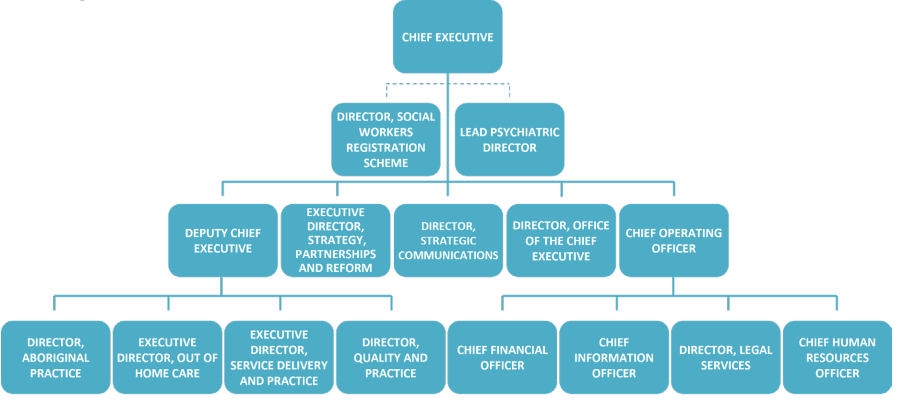 | |
Changes to the agency | |
The following changes to the agency’s structure took place during 2023-24 as a result of internal reviews:
| |
| |
Our Executive teamAs at 30 June 2024, the department’s Executive team comprised:
| |
Legislation administered by the agency
| |
 Our Minister
Performance at a glance
The DCP Strategic Plan 2022-2026 sets out seven key departmental priorities to deliver on its vision for all children and young people to grow up safe, healthy, connected and feeling loved so they reach their full potential:
- Leaders in practice excellence
- Closing the gap
- A child protection and family support system that meets the needs of children and young people
- A thriving workforce
- Active and collaborative partnerships
- Working alongside carers
- Quality service and safeguarding.
This year, the department progressed a program of improvement and reform activities against each of these priorities, set out in the DCP Action Plan 2023-24.
Keeping children safe at home and improving outcomes for children and young people in contact with the child protection and family support system requires sustained effort, not just by DCP but from others across government and the community.
DCP has sought to maximise outcomes for children, young people and families through building effective partnerships with other government agencies, non government organisations, Aboriginal Community Controlled Organisations and community groups, and by establishing clear accountability and governance for our performance across government.
Notwithstanding the continued growth in demand for services in 2023-24, DCP has continued to improve its performance in a range of areas, including:
- Slowing the rate of children and young people entering care to the lowest rate in over a decade Continuing to invest in family support, family led decision making, family group conferencing and reunification services
- Adding Kornar Winmil Yunti Aboriginal Corporation (KWY) as a recognised Aboriginal organisation for consultation regarding the placement of an Aboriginal child or young person in care
- Expanding the scope of the Taikurtirna Warri–apinthi Program to include all DCP country offices to assist with identifying placement options for Aboriginal and Torres Strait Islander infants, children and young people with Aboriginal and Torres Strait Islander kin and community
- Providing funding to SNAICC – National Voice for Our Children to support the establishment of Wakwakurna Kanyini, the peak body for Aboriginal children and families
- Recruiting 10 additional principal Aboriginal consultants to increase frontline support
- Implementing strategies to ensure young people can grow up in family-based settings
- Expanding our programs to support young people leaving care, including transitioning to a new post care model and implementing Stability Post Care Individual Packages for young people
- Approving 313 new family-based carers
- Establishing the Kinship Care Learning and Development program, which includes tailored training packages for kinship carers, while also creating opportunities for carers to engage in the review and development of departmental policy, programs and reform through the new Carers Voice webpage
- Introducing flexible respite support payments to assist carers in their caring responsibilities
- Establishing the Carer Council
- Launching the Child Protection and Family Support Sector Workforce Strategy, the first of its kind for South Australia
- Hosting the inaugural Child Protection and Family Support Symposium to help inform the Child Protection Expert Group in developing a 20-year vision for child protection and family support in South Australia.
| Children in care | 30 Jun 20 | 30 Jun 21 | 30 Jun 22 | 30 Jun 23 | 30 Jun 24 |
| Foster Care | 1,641 | 1,705 | 1,669 | 1,666 | 1,615 |
| Kinship Care | 2,090 | 2,247 | 2,327 | 2,406 | 2,447 |
| Family Day Care | 40 | 41 | 35 | 43 | 51 |
| Independent Living | 63 | 50 | 60 | 48 | 57 |
| Residential Care | 413 | 604 | 649 | 701 | 721 |
Agency specific objectives and performance
| Agency objectives | Indicators | Performance |
| Leaders in practice excellence - Staff in all parts of child protection develop and use best practice in their work to deliver improved outcomes for children, young people, carers and families. | Grow the use of Family Group Conferences. | Expanded access to Family Group Conferencing across the state with a focus on Aboriginal and Torres Strait Islander families and including for unborn child concerns. Held 284 Family Group Conferences, involving over 500 children and young people. |
| Update practice directions and training specific to child neglect. | Developed practice guidance and led professional development training to case workers on working with concerns about neglect, hoarding and substandard living conditions. | |
| Closing the gap - We commit to a transformed child protection system that makes active efforts and where Aboriginal people and communities are empowered to lead decision making about the care and wellbeing of Aboriginal children and young people. | Support the implementation of a Peak Body for Aboriginal children and young people | Funded the establishment of Wakwakurna Kanyini, the Peak Body for Aboriginal Children and Families. |
| Recruit additional Aboriginal Practice Leaders. | Recruited 10 additional Principal Aboriginal Consultants to increase frontline support. | |
| Lead Closing the Gap initiatives in Department for Child Protection. | Progressed planning for the child protection schedule under South Australia’s Closing the Gap Implementation Plan. Key initiatives: Expanded Family Group Conferencing Declared KWY as a recognised Aboriginal organisation Provided funding to SNAICC – National Voice for Our Children to support the establishment of Wakwakurna Kanyini Formalised an MOU with SAACCON Expanded the focus on family scoping, reunification and family led decision making o Added Kornar Winmil Yunti Aboriginal Corporation (KWY) as a recognised Aboriginal organisation for consultation regarding the placement of an Aboriginal child or young person in care Expanding the scope of the Taikurtirna Warri–apinthi Program to include all DCP country offices to assist with identifying placement options for Aboriginal and Torres Strait Islander infants, children and young people with Aboriginal and Torres Strait Islander kin and community. | |
| Working alongside carers - We respect and value carers as vital partners in keeping children and young people safe and well. | Establish a Carer Council. | Established a Carer Council with 12 family-based carers, five from regional South Australia. |
| Launch a refreshed Statement of Commitment to foster and kinship carers. | Worked with the newly established Carer Council on the Statement of Commitment. | |
| Fast track flexible respite arrangements to ensure timely access to respite care in a way that works for carers and the children for whom they care. | Introduced flexible respite support payments to assist carers in their caring responsibilities, offering an additional $800 per year towards respite-like supports, including gardening, cleaning or transport. | |
| Develop a mechanism to support carers with accessing therapeutic assessments and support including establishing carer connect forums. | Established Carer Connect, providing foster and kinship carers access to the department’s therapeutic support team with an inaugural forum held on supporting children aged 2-12 with Autism. | |
| Provide increased opportunities for carer training. | Introduced a new tailored training package for kinship carers of Aboriginal and Torres Strait Islander children and continued to promote an online trauma training package for foster and kinship carers. Delivered training to over 400 kinship carers through the new DCP Kinship Care Learning and Development Program. | |
| Develop mechanism for Carer Consultation. | Created opportunities to engage family-based carers on targeted matters to inform policy, projects and services initiated by DCP via a new Carers Voice webpage. | |
| A thriving workforce - We are future focused in our workforce strategy, supporting and valuing our staff, proactively recruiting, and establishing sustainable systems, processes and workplaces that enable us to be highly effective. | Deliver a DCP Aboriginal Employment Action Plan. | Developed and launched the Aboriginal Workforce Action Plan 2024-26. |
| Develop and launch a sector-wide child protection workforce strategy to ensure sustainable, safe staffing levels for the future. | Released the Child Protection and Family Support Sector Workforce Strategy, with priority actions to gain, train and retain a skilled and well supported workforce, the first of the kind for South Australia. | |
| Implement office Wi-Fi for enhanced collaboration and efficiency. | Provisioned Wi-Fi to all DCP sites, enabling enhanced collaboration and efficiency, including for site guests. | |
| Develop a comprehensive business case for the replacement of C3MS. | Supplied funding through the Digital Investment Fund for Phase 1 eCARL and eLOG enhancements as part of DCP’s Digital and Business Transformation Program by developing a comprehensive business case outlining requirements for the replacement of C3MS. | |
| Active and collaborative partnerships - We work together with our service partners and alongside the community to improve outcomes for children, young people, carers and families. | Develop and commence implementation of a joint plan of action with SA Health and the Office for Recreation, Sport and Racing and the Department for Education. | Established new joint Plans of Action with SA Health, the Department for Education and the Office for Recreation, Sport and Racing to collaboratively pursue improved outcomes for children and young people in care. Partnered with sporting clubs to provide children and young people in care with access to equipment, sporting activities and events. |
| Develop an MoAA with the Office of the Public Advocate. | Signed an MoAA outlining roles and responsibilities of DCP and the Office of the Public Advocate, to support the smooth transition of young people to adult guardianship. | |
| Refresh existing MoAAs with Aboriginal Community Controlled Organisations. | Reviewed DCP’s key agreements with Aboriginal Community Controlled Organisations. Co-signed an MoU with SAACCON that establishes a transparent, and accountable policy and place-based partnership to reduce the overrepresentation of Aboriginal and Torres Strait Islander children in contact with the child protection system. | |
| Establish a data sharing agreement with the South Australia Certificate of Education Board. | Co-signed a data sharing agreement with the South Australia Certificate of Education Board to support positive education outcomes for young people in care. | |
| A child protection and family support system that meets the needs of children and young people - We commission and deliver services based on a deep understanding of the needs of children and young people in care and our aspirations for them to heal from trauma and reach their full potential. | Embed the Sanctuary model in residential care. | Further embedded the Sanctuary Model of Therapeutic Care, including training 93% of DCP Residential Care staff in the model. A total of 9 training sessions were held in 2023-24. |
| Commission and operationalise the Stability Post Care Individual Packages pilot program for young people leaving care, including to ensure priority housing is available to children leaving care as young adults. | Commenced the Stability Post Care Individual Packages pilot program for young people leaving care from NGO residential care. | |
| Develop staff and carer resources to raise awareness of children’s development. | Developed resources for staff and carers to raise awareness of issues impacting children’s development. | |
| Transition to the new Post Care Service model, including additional funding for the recommissioned Post Care Support Services to support young people leaving care to obtain housing/ accommodation. | Transitioned to a new post care model and implemented Stability Post Care Individual Packages to better support young people leaving care. | |
| Continue to expand the Disability and Development Program, extending its focus on staff and carer training, autism specific activities and sector engagement. | Expanded the Program, including: providing regular training to kinship carers supported by DCP case workers, residential care staff and Aboriginal Community Controlled Organisations developing new training resources on Fetal Alcohol Spectrum Disorder (FASD) and Autism, and providing input on the development of training materials to be used in partnership with sporting organisations supporting the participation of children and young people in care with disabilities in sport. | |
| Quality services and safeguarding - We are accountable and transparent, and pursue continuous improvements to promote the safety and wellbeing of children and young people throughout the services we fund and provide. | Establish the South Australian Child Protection Expert Group. | Established the South Australian Child Protection Expert Group, with government and nongovernment members from across Australia who have recognised expertise in child protection research, policy and practice. Also commenced working group for the Symposium providing specific advice to development. |
| Implement the new child and young person survey and increase the participation of children and young people in decision making. | Implemented My Voice Our Views, a new survey tool to support children and young people’s participation in decision making. | |
| Implement a new licensing framework for service providers. | Implemented a new licensing framework for service providers to uphold and strengthen the delivery of high-quality services that safeguard children and young people. | |
| Facilitate the department’s transition to new governmentwide preferred banking provider. | Transitioned to the new whole of government banking provider. | |
| Establish the Direct Experience Group. | Established a new advisory group comprising families and parents with direct experience of the child protection and family support system, who meet regularly and collectively use their experience to contribute to reform. |
Corporate performance summary
During 2023-24, DCP continued to progress and deliver on key corporate initiatives,
including having:
- Developed the Child Protection and Family Support Sector Workforce Strategy and releasing it for sector consultation.
- Hosted the inaugural Child Protection and Family Support Symposium to inform a South Australian 20 year vision for child protection and family support.
- Worked in partnership to renew Memorandums of Administrative Arrangements (MoAAs) with Aboriginal Community Controlled Organisations and established new MoAAs with the Office of the Public Advocate and the South Australian Aboriginal Community Controlled Organisations Network.
- Together with other agencies, opened a new multi-agency facility on the APY Lands to provide community safety and child protection services.
- Increased procurement from Aboriginal Community Controlled Organisations (ACCOs) to 10.23%.
- Implemented a new licensing framework for service providers to uphold and strengthen the delivery of high-quality services that safeguard children and young people.
- Developed a comprehensive business case for the replacement of the department’s electronic client case management system.
- Relocated the Whyalla DCP office to new premises and undertook planning to move DCP staff from Netley Commercial Park to the new facility at Keswick.
- Hosted the third annual South Australian Child Protection Awards, recognising the outstanding achievements of children and young people, carers, volunteers, staff and organisations from across the child protection sector.
Employment opportunity programs
| Program name | Performance |
|---|---|
| Aboriginal Employment | Following implementation of the DCP Aboriginal Workforce Action Plan 2024-2026, DCP has a clear commitment to enhancing employment opportunities for Aboriginal and Torres Strait Islander people in all areas of the agency. As at 30 June 2024, 138 employees (5.0%) identified as Aboriginal and Torres Strait Islander. |
| Disability Employment | DCP’s Disability Access and Inclusion Plan 2020-2024 continues to be implemented. The plan outlines the department’s commitment to increasing disability employment in the organisation and supporting employees with disability. To support a more inclusive recruitment process, DCP has partnered with JobAccess who have provided Disability Awareness training to enhance employment opportunities for people with disabilities. As at 30 June 2024, 33 employees declared they have a disability. |
| Gender Equality & Respect | DCP continues to be a White Ribbon Accredited Workplace, reaffirming our commitment to ending gendered violence against women, and supporting employees in our workplace who may be experiencing domestic violence. The department has commenced a new White Ribbon Accreditation process, which will be finalised in April 2025 and will extend the current accreditation for a further 5 years. DCP has a number of supports in place for employees experiencing domestic and family violence, including the Domestic and Family Violence Workplace Procedure and Workplace Domestic and Family Violence Safety Plan. |
| Diversity & Inclusion | DCP respects and values the diversity of its employees, clients and partners, and is committed to a diverse and inclusive workforce. The department is currently developing a new diversity and inclusion strategy, which will be informed by government wide strategies including the Anti-Racism Strategy and Action Plan. |
Agency performance management and development systems
| Performance management and development system | Performance |
|---|---|
| Performance Development Plans | As at 30 June 2024, 76% of employees had recorded a Performance Development Plan (PDP) completed within the previous six months. Compliance rates are reported to leaders and monitored on a monthly basis. DCP is committed to improving PDP completion rates and, effective January 2024, has digitised this process by moving all performance development plans on to our Human Capital Management System, Pledge. In February 2024, DCP standardised the PDP approach to ensure all plans are completed in April and October each year with a communication and education drive across the agency. This has resulted in an increased completion rate across the agency. |
Work health, safety and return to work programs
| Program name | Performance |
|---|---|
| Work, Health and Safety Risk Management | Staff safety and wellbeing remains paramount to DCP. In 2023-24, the department focused on its leadership commitment to safety, wellbeing and injury management through provision of detailed data analytics at forums such as the Work, Health and Safety Peak Governance Committee, to allow senior leaders to make informed decisions, as well as the introduction of a DCP Wellbeing Partner to provide inhouse wellbeing support for staff in residential care, to complement the services provided by DCP’s Employee Assistance Program. The Employee Assistance Program is delivered by a panel of 3 providers and provides access to 24/7 service provision and an Aboriginal and Torres Strait Islander specific provider to enhance culturally appropriate wellbeing services. |
| Injury Management | In 2023-24, DCP focused on strategies to reduce the incidence of slips, trips and falls and used a holistic approach to develop corrective measures to improve return to work outcomes. Training materials for managers to increase understanding of injury management processes are currently being developed. This is a key measure to continue to improve early injury reporting, which enhances our preventive strategies, improves workers’ return to work outcomes and injured workers’ wellbeing, and will also assist in reducing workers compensation financial costs. |
| Workplace injury claims | Current year 2023-24 | Past year 2022-23 | % Change (+ / -) |
|---|---|---|---|
| Total new workplace injury claims | 129 | 127 | +2% |
| Fatalities | 0 | 0 | 0% |
| Seriously injured workers* | 0 | 2 | -100% |
| Significant injuries (where lost time exceeds a working week, expressed as frequency rate per 1000 FTE) | 32.63 | 28.60 | +14% |
*number of claimants assessed during the reporting period as having a whole person impairment of 30% or more under the Return to Work Act 2014 (Part 2 Division 5)
| Work health and safety regulations | Current year 2023-24 | Past year 2022-23 | % Change (+ / -) |
|---|---|---|---|
| Number of notifiable incidents (Work Health and Safety Act 2012, Part 3) | 7 | 3 | +133% |
| Number of provisional improvement, improvement and prohibition notices (Work Health and Safety Act 2012 Sections 90, 191 and 195) | 2 | 4 | -50% |
| Return to work costs** | Current year 2023-24 | Past year 2022-23 | % Change (+ / -) |
|---|---|---|---|
| Total gross workers compensation expenditure ($) | 8,712,690 | 4,994,296 | +74% |
| Income support payments – gross ($) | 3,887,830 | 2,453,000 | +59% |
**before third party recovery
Data for previous years is available at: https://data.sa.gov.au/data/dataset/workhealth-
safety-and-return-to-work-performance-for-dcp
Executive employment in the agency
| Executive classification | Number of executives |
|---|---|
| EXECOF | 1 |
| SAES 2 | 8 |
| SAES 1 | 13 |
Data reflects the number of employees under an executive contract as at 30 June 2024. This figure does not include vacancies or persons employed on executive backfill arrangements (non-executive contracts) at this date. The Office of the Commissioner for Public Sector Employment has a workforce information page that provides further information on the breakdown of executive gender, salary and tenure by agency.
Financial performance at a glance
The following is a brief summary of the overall financial position of the agency. The information is unaudited. Full audited financial statements for 2023-2024 are attached to this report.
| Statement of Comprehensive Income | 2023-24-Budget $000s | 2023-24 Actual $000s | Variation $000s | Past year 2022-23 Actual $000s |
|---|---|---|---|---|
| Total Income | 794 801 | 900 239 | 105 438 | 793 109 |
| Total Expenses | 790 836 | 906 856 | 116 020 | 810 878 |
| Net Result | 3 965 | (6 617) | (10 582) | (17 769) |
| Total Comprehensive Result | 3 965 | (1 827) | (5 792) | (416) |
| Statement of Financial Position | 2023-24 Budget $000s | 2023-24 Actual $000s | Variation $000s | Past year 2022-23 Actual $000s |
|---|---|---|---|---|
| Current assets | 71 452 | 47 708 | (23 744) | 36 354 |
| Non-current assets | 54 497 | 72 138 | 17 641 | 66 359 |
| Total assets | 125 949 | 119 846 | (6 103) | 102 713 |
| Current liabilities | 76 074 | 119 846 | 6 632 | 70 244 |
| Non-current liabilities | 51 443 | 82 706 | 11 104 | 59 872 |
| Total liabilities | 127 517 | 145 253 | 17 736 | 130 116 |
| Net assets | (1 568) | (25 407) | (23 839) | (27 403) |
| Equity | (1 568) | (25 407) | (23 839) | (27 403) |
Consultants disclosure
The following is a summary of external consultants that have been engaged by the agency, the nature of work undertaken, and the actual payments made for the work undertaken during the financial year.
Consultancies with a contract value below $10,000 each
| Consultancies | Purpose | $ Actual payment |
|---|---|---|
| All consultancies below $10,000 each - combined | Various | $8 769 |
Consultancies with a contract value above $10,000 each
| Consultancies | Purpose | $ Actual payment |
|---|---|---|
| OPEX NOMINEES PTY LTD | Procurement advisory services for the Social Workers Registration Scheme (SWRS) | $39 800 |
| DUCK & PARTNERS PTY LTD T/A DUCK POND SOLUTIONS | Learning and Development Strategy review | $27 020 |
| PAUL NIXON ASSOCIATES LTD | Family Group Conferencing advisory services | $20 211 |
| Total | $87 031 |
Data for previous years is available at:
https://data.sa.gov.au/data/dataset/consultants-utilised-in-department-for-childprotection
See also the Consolidated Financial Report of the Department of Treasury and Finance for total value of consultancy contracts across the South Australian Public
Sector.
Contractors disclosure
The following is a summary of external contractors that have been engaged by the agency, the nature of work undertaken, and the actual payments made for work undertaken during the financial year.
Contractors with a contract value below $10,000
| Contractors | Purpose | $ Actual payment |
|---|---|---|
| All contractors below $10,000 each - combined | Various | $109 524 |
Contractors with a contract value above $10,000 each
| Contractors | Purpose | $ Actual payment |
|---|---|---|
| HAYS SPECIALIST RECRUITMENT | HR – Staffing services | $282 990 |
| TALENT INTERNATIONAL (SA) P/L | HR – Staffing services | $194 900 |
| RANDSTAD PTY LTD | HR – Staffing services | $153 643 |
| PERNIX PTY LTD | Professional services –ICT services | $152 650 |
| DATACOM SYSTEMS (AU PTY LTD) | Professional services –ICT services | $74 255 |
| EDGE RECRUITMENT | HR – Staffing services | $69 822 |
| TAPTU PTY LTD | Professional services –ICT services | $49 968 |
| PAN SOFTWARE PTY LTD | Professional services –ICT services | $46 000 |
| YOUR DC PTY LTD | Professional services –ICT services | $45 920 |
| KPMG | Professional services –ICT services | $45 060 |
| ATLASOPEN PTY LTD | Professional services –Child Survey Projects | $44 793 |
| GORDON MCINTYRE CONSULTING | HR – Staffing services | $44 633 |
| JONES LANG LASALLE ADVISORY | Professional services –Asset valuation | $39 000 |
| KATINA D’ONISE CONSULTING | Professional services –Quality and practice | $37 500 |
| PAXUS AUSTRALIA PTY LTD | HR – Staffing services | $34 042 |
| CDM Australia PTY LTD | Professional services –ICT services | $33 600 |
| AKKODIS AUSTRALIA TALENT | HR – Staffing services | $31 959 |
| GIRL ABOUT TOWN PTY LTD | Professional services –production | $23 611 |
| ORCHARD TALENT GROUP PTY LTD | HR – Staffing Services | $20 779 |
| PAUL NIXON ASSOCIATES LTD | Professional Services –Quality and practice | $19 205 |
| VENDOR PANEL PTY LTD | Professional services – ICT services | $18 315 |
| FRANCA PETRONE | Professional services – Redress services | $15 362 |
| ONE PACIFIC DISPUTE RESOLUTION | Professional services –Redress services | $15 223 |
| CHAMONIX IT MANAGEMENT | Professional services –ICT services | $15 138 |
| NEXT GENERATION SECURITY | Professional services –ICT services | $12 232 |
| COMMUNITY TRANSITIONS | Professional services –Redress services | $11 927 |
| MAXIMA TRAINING GROUP (AUST) | HR – Staffing services | $11 865 |
| NEC AUSTRALIA P/L | Professional services –ICT services | $10 712 |
| Total | $1 555 104 |
Data for previous years is available at:
https://data.sa.gov.au/data/dataset/contractors-utilised-by-dcp
The details of South Australian Government-awarded contracts for goods, services, and works are displayed on the SA Tenders and Contracts website. View the agency list of contracts.
The website also provides details of across government contracts.
Risk and audit at a glance
DCP maintains a robust risk and internal control environment supported by an effective Internal Audit and Risk function, Performance and Risk Committee (PRC) and associated internal audit and risk management frameworks.
The department has a rolling three-year Internal Audit Plan that is reviewed annually and updated to reflect current risks and priorities. Progress against the plan is monitored and reported to the Senior Executive Group (SEG) and PRC on a regular basis, along with the status and progress of actions arising from internal audit, Auditor General and Control Self-Assessment reviews.
In line with the Risk Assessment Framework, strategic and operational risk registers are formally reviewed on a six-monthly basis. All strategic, operational and fraud risks are recorded and monitored using the Risk Console system to improve the efficiency and usefulness of risk monitoring, review and reporting. Additionally, the Internal Audit and Risk team facilitated a workshop with SEG members and PRC members to identify any emerging or new strategic risks for the department.
For 2023-24, the key ongoing areas of risk included the:
- Need for continued focus on, and progress tracking against, high priority internal audit and Auditor General action items.
- Tight fiscal environment, budgetary pressures and the case mix (particularly out of home care).
- Difficulty across government in identifying and addressing the underlying issues contributing to the high number of Aboriginal and Torres Strait Islander children in care.
- Need for management to continually review existing and emerging risks in the context of the child protection environment and the department’s risk appetite.
The overall internal audit opinion for 2023-24 did not identify any significant issues, concerns or risks that indicated the overall risk and control environment was not effective.
Fraud detected in the agency
| Category/nature of fraud | Number of instances |
|---|---|
| Misrepresentation of hours worked / leave accrued in timesheet, false declaration on official government documents | 2* |
| Use of petty cash for personal purposes (theft and fraud) | 1** |
| Failed to advise of a previous workers compensation claim on pre-employment declaration and screening | 1 |
NB: Fraud reported includes actual and reasonably suspected incidents of fraud.
*One investigation continuing, one finalised in 2023-24
**Investigation continuing
Strategies implemented to control and prevent fraud
DCP is committed to the prevention, detection and control of fraud, corruption and other criminal conduct, misconduct and maladministration in connection with the activities of the department. Fraud risks are identified as part of the department’s risk management activities and are captured in a Fraud Risk Register.
The DCP Fraud and Corruption Control Framework, adopted from the South Australian Public Sector Fraud and Corruption Control policy, aligns with Australian Standard – AS 8001:2021 Fraud and Corruption Control. It is designed to assist in the prevention, detection and response to activities labelled or defined as fraud.
DCP continued to undertake a range of corporate and operational activities to prevent and detect fraud in accordance with the Framework, including regular review of financial management policies and procedures, a comprehensive internal audit program, undertaking strategic and operational risk assessments, and raising the general awareness of fraud amongst staff.
The DCP Internal Audit and Risk team carried out operational risk assessments across key areas of the business, with regular reviews of fraud risks pertinent to specific business functions. Operational risk registers were continually assessed and updated, in line with the Risk Assessment Matrix. Fraud risks continued to be captured through operational risk workshops and through the Fraud Risk Register.
DCP addresses any suspected, alleged or proven instances of fraud, corruption or other criminal conduct, misconduct or maladministration by employees or other public officers, including through:
- Investigation by appropriately skilled and experienced personnel who are
independent of the business unit in which the alleged conduct occurred. - Reporting to the Office for Public Integrity or Ombudsman.
- Involvement of other authorities such as South Australia Police.
- Compliance with the Public Interest Disclosure Act 2018.
Public interest disclosure
Number of occasions on which public interest information has been disclosed to a responsible officer of the agency under the Public Interest Disclosure Act 2018:
0
Data for previous years is available at: https://data.sa.gov.au/data/dataset/publicinterest-disclosures-for-the-department-for-child-protection
Note: Disclosure of public interest information was previously reported under the Whistleblowers Protection Act 1993 and repealed by the Public Interest Disclosure Act 2018 on 1/7/2019.
| Act or Regulation | Requirement |
|---|---|
| Children and Young People (Safety) Act 2017 | Part 4 – Additional Reporting Obligations of the Chief Executive Section 156(1) The Chief Executive must, not later than 30 September in each year, submit to the Minister a report setting out: |
DCP’s capacity to report on section 156(1)(a)(ii) and (iii) is in development. As at 30 June 2024:
- The rate of case plan completion for Aboriginal and Torres Strait Islander children and young people in care is 93.8%.
- 93.5% of Aboriginal and Torres Strait Islander children and young people in care have a current and approved Aboriginal and Torres Strait Islander Cultural Identity Support Tool.
| Act or Regulation | Requirement |
|---|---|
| Children and Young People (Safety) Act 2017 |
Part 4 – Additional Reporting Obligations of the Chief Executive Section 156(1) The Chief Executive must, not later than 30 September in each year, submit to the Minister a report setting out: (b) the following information relating to case workers and children and young people in care: (i) whether a case worker has been allocated to each child and young person in care, (ii) whether each child and young person in care has had face to face contact with their allocated case worker at least once in each month, and, if not, the extent to which those targets have been achieved, and (c) whether each child or young person under the guardianship of the Chief Executive until they are 18 years of age has a case plan that is developed, monitored and reviewed as part of a regular 6 monthly planning cycle and, if not, the extent to which that target has been achieved, and (d) the emergence of any recurring themes in the matters referred to in a preceding paragraph, and (e) the following information relating to recommendations of the Child Protection Systems Royal Commission (being information relating to the preceding financial year): (i) the extent to which any outstanding recommendations have been implemented, (ii) if a decision was made to implement a particular recommendation that the government, or the Minister or Chief Executive, had previously indicated would not be implemented— the reasons for that decision and the manner in which the recommendation is to be implemented, (iii) if a decision was made not to implement a particular recommendation that the government, or the Minister or Chief Executive, had previously indicated would be implemented—the reasons for that decision, and (f) the number, and general nature, of placements of children and young people under section 77, and (g) any other matter prescribed by the regulations for the purposes of this paragraph. |
- As at 30 June 2024, all children and young people in care were allocated to a Primary Assigned Case Worker.
- DCP has reviewed the Data & Analytics Hub report with the intention to better support service provision through access to enhanced data analysis and operational reporting, including monitoring how many children and young people have had face to face contact with their allocated case worker.
- As at 30 June 2024, 94.0% of children and young people had a current and approved case plan.
- In the period 1 July 2023 to 30 June 2024, a further 4 recommendations of the Child Protection Systems Royal Commission were completed. As at 30 June 2024, of the 260 recommendations, 250 recommendations were completed and 6 recommendations were yet to be completed (noting 4 recommendations were not accepted).
- To meet the reporting requirements of section 156(1)(e), DCP has published a comprehensive multi-agency annual report outlining the state government’s progress implementing the Child Protection Systems Royal Commission recommendations. This report is available on the DCP website via the following
link: www.childprotection.sa.gov.au/research-and-publications/publications/childprotection-
systems-royal-commission - As of 1 July 2023, 393 children and young people were placed with a temporary carer.
- Of these 393 children and young people:
- 318 children and young people remain in care as at 30 June 2024
- 75 children and young people are no longer in care as at 30 June 2024.
| Act or Regulation | Requirement |
|---|---|
| Children and Young People (Safety) Act 2017 |
Section 15 – Additional annual reporting obligations (1) The Minister must, not later than 30 September in each year, prepare a report: – (a) detailing the role of the Minister, and the extent to which the Minister has performed the Minister's functions, in respect of the operation of this Act for the financial year ending on the preceding 30 June. |
This annual report details the role of the Minister and the extent to which the Minister has performed the Minister’s functions for the 2023-24 financial year. In addition, to help ensure outcomes for children and young people are at the centre of our efforts, the Minister has:
- Committed to improving the South Australian child protection and family support system and its capacity to meet the needs of children, young people, families, carers and communities:
- Hosted the inaugural Child Protection and Family Support Symposium to reimagine the system of the future.
- Prepared the Child Protection and Family Support Sector Workforce Strategy, the first of its kind for South Australia.
- Broadened our learnings in contemporary child protection practice, through travelling to Scotland and England in the United Kingdom to understand how these jurisdictions have engaged their communities in whole of system change and to further inform our approach to child protection reform in South Australia.
- Continued engagement of the NEWPIN Program through a joint State-Commonwealth Social Impact Bond arrangement, supporting families to promote wellbeing, improve parenting capacity and develop positive family relationships including reunification.
- Engaged with new governance groups established by the Minister to support and inform child protection and family support services and reform:
- Chaired the Chief Executive Governance Group which drives child protection and family support system reform across government.
- Referred matters for advice to the Child Protection Expert Group.
- Appointed and consulted with members of the Carer Council.
- Appointed and consulted with members of the Direct Experience Group.
- Increased funding to the Office of the Guardian for Children and Young People to support the Guardian in delivering her statutory functions.
- Introduced flexible respite support payments to assist carers in their caring responsibilities.
- Signed the Partnership Agreement on behalf of South Australia between governments and Aboriginal and Torres Strait Islander leaders that underpins implementation of Safe and Supported: the National Framework for Protecting Australia’s Children 2021-2031.
Appointed the inaugural Social Workers Registration Board to support the registration of social workers and commenced implementation planning for the Scheme.
| Act or Regulation | Requirement |
|---|---|
| Children and Young People (Safety) Act 2017 |
Section 15 – Additional annual reporting obligations (1) (b) setting out the following information relating to the provision of family support services and intensive family support services to children and young people who are at risk and their families: (i) the extent to which such services were provided by, or on behalf of, the State (including statistical data relating to the number of times such services were provided) during the financial year ending on the preceding 30 June, (ii) the amount of resources allocated for the provision of such services by or on behalf of the State – (A) during the financial year ending on the preceding 30 June, and (B) during the current financial year, (iii) the extent to which the allocated resources were, in fact, spent on the provision of such services during the financial year ending on the preceding 30 June. |
The following information summarises the delivery of programs/services that relate to the provision of family support services and intensive services to children and young people who are at risk and their families.
| Program/ Service | Description and Summary of Outcomes in 2023-24 | Financial Information | ||
|---|---|---|---|---|
| 2024-25 Budget $m | 2023-24 Actual expenditure $m | 2023-24 Budget $m | ||
1. Child and Family Support System The Child and Family Support System (CFSS) comprises a range of services and programs delivered by government and non-government services with the primary aim to keep children safe and well in family, community and culture. | ||||
| Tier 1: Out of home care prevention and intergenerational impact | ||||
|
Out of home care prevention and intergenerational impact programs |
Intensive band of family support programs focused on providing supports to families at imminent risk of having their children placed in care and a specific service working with young women under 25 whose children have been removed and are at risk of repeat removals of future children. There were 122 families accepted with an associated 313 children, and 5 young women accepted during 2023-24. | 5.4 | 5.3 | 5.3 |
| Tier 2: Intensive Family Services | ||||
|
Intensive Family Services |
Intensive Family Services (IFS) delivered by the Department of Human Services (DHS) and through partnerships with nongovernment organisations, (including Aboriginal Community Controlled Organisations (ACCOs)). Services provide targeted support for 6-9 months to families with children aged 0-18
years with multiple and complex needs, who have been identified as high to very high risk of deepening involvement of the statutory child protection system. There were 1,416 families (referrals) with 3,053 associated children accepted for Intensive Family Services during 2023-24. | 38.9 | 33.4 | 37.5 |
| Tier 3: Family Support Services | ||||
|
Strong Families Strong Communities Program This is a newly commissioned program and replaces the Community Services Support Program which ceased as of 30 June 2023. |
Strong Families Strong Communities is a family support program providing effective intervention by the nongovernment sector to assist families with medium to low level risk concerns. The new program commenced 1 July 2023. | 4.2 | 4.4 | 4.1 |
|
Community Development Coordinator Program |
Community Development Coordinators (CDCs), funded by DHS, are based within Children’s Centers, using a community development approach to improve outcomes for children. Together with local families and groups, they work to identify and strengthen protective factors within a community,
enabling codesigned and co-owned programs, and mobilising local resources. Statewide, 40 CDCs engaged with 20,702 families during 2023-24 in a range of programs, group activities and community events. | 4.8 | 4.3 | 4.6 |
|
Parenting and Family Support Program DHS holds strategic and operational oversight of Parenting SA. SA Health employ and accommodate staff. | Families Growing Together and Parenting SA deliver parenting programs via face-to-face and online formats, and through Parent Easy Guides that delivers state-wide support. Families Growing Together is funded by DHS and supported 1,687 families during 2023-24. | 0.8 | 0.7 | 0.8 |
|
Family by Family Program |
Family by Family is funded by DHS and delivered by a nongovernment organisation. This peer support program is a network of families supporting other families to make lasting changes and includes support to families at risk of child abuse and neglect, and escalation into the statutory child protection system. There were 132 families with 286 associated children supported during 2023-24. | 2.0 | 1.9 | 1.9 |
| CFSS Referral System | ||||
|
Pathways Service and Child and Family Safety Networks (CFSNs) |
Referrals into IFS are through the DHS CFSS Pathways Service (which was established in 2021 to provide a single point of entry). The service captures family information to inform system reform and to match families to appropriate services. CFSNs are multi-agency networks that provide regional coordinated responses to referrals (pre-birth to 18 years) from the CFSS Pathways Service. Work includes planning, service allocation, and clinical collaboration. Members include government, non-government, and Aboriginal Community Controlled Organisations (ACCOs). Pathways Service and CFSNs processed a total of 3,879 referrals in 2023-24. | 3.9 | 3.8 | 3.8 |
| Act or Regulation | Requirement |
|---|---|
| Children and Young People (Safety) Act 2017 |
Section 15 – Additional annual reporting obligations (1) (b) The Minister must, not later than 30 September in each year, prepare a report – :(iv) bench-marking the resources referred to in subparagraph (ii) and (iii) against those allocated and spent by other States and Territories in the provision of such services during the financial year ending on the preceding 30 June. |
The Report on Government Services (ROGS) details this information. It is published in January each year and is available from
https://www.pc.gov.au/research/ongoing/report-on-government-services
| Act or Regulation | Requirement |
|---|---|
| Children and Young People (Safety) Act 2017 |
Section 15 – Additional annual reporting obligations (1) (c) providing any other information required by the regulations for the purposes of this paragraph. |
| Indicators of Performance | Performance 2023-24 | Performance Comparison to 2022-23 | |
|---|---|---|---|
| Responding to notifications |
Total calls made to the Call Centre | 63,637 |
In 2023-24, the number of calls to the Call Centre increased by 1.0% from 2022-23 (62,980). In 2023-24, the Call Centre answered 1,432 more calls than in 2022- 23 (50,345). |
| Responding to notifications |
Number of calls answered | 51,777 | |
| Responding to notifications |
Average wait time to the Child Abuse Report Line | 11 min 05 sec | The average wait time to the Child Abuse Report Line (CARL) in 2023-24 was one minute and 18 seconds less than 2022-23 (12 min 23 sec). |
| Responding to notifications |
Number of eCARL submissions | 55,575 | There were 4,256 (8.3%) more eCARL submissions in 2023-24 than in 2022-23 (51,319). |
| Responding to notifications |
Total number of notifications referred for an alternative response |
Of the 20,197, notifications referred: 9,628 were referred to an appropriate State Authority 1,114 were referred to another agency 9,455 were referred for another outcome, including Refer Relevant Agency, family meeting, case management response or internal service response. | There were 277 (1.4%) more alternative responses in 2023-24 than in 2022-23 (19,920) |
| Child protection responses |
Number of notifications | 98,931 (24,291 for Aboriginal and/or Torres Strait Islander children and young people) | |
| Child protection responses |
Number of screened-in notifications | 39,957 (11,185 for Aboriginal and/or Torres Strait Islander children and young people) |
In 2023-24, there were 5,980 (6.4%) more notifications received than in 2022-23 (92,951).
There were 442 (1.1%) more notifications screened-in for further assessment and response in 2023-24, than in 2022-23 (39,515*). Of the 2023-24 notifications, 40.4% were screened-in compared to 42.5% screened-in for 2022-23. Notifications for Aboriginal and/or Torres Strait Islander children and young people comprised 24.6% of all notifications in 2023-24 compared to 24.5% (22,759) in 2022-23 and 28.0% of screened-in notifications compared to 27.9% (11,020*) in 2022-23. |
| Children placed on child protection orders |
Total children placed on orders | 1,581 (582 for Aboriginal and/or Torres Strait Islander children and young people) |
The number of children placed on an order decreased by 142 (8.2%) compared to 2022-23 (1,723). Aboriginal and/or Torres Strait Islander children and young people comprised 36.8% of children placed on an order in 2023-24 compared to 36.2% (686) in 2022- 23. |
| Children placed on child protection orders | Children placed on orders for first time | 705 (256 for Aboriginal and/or Torres Strait Islander children and young people) |
The number of children placed on an order for the first time decreased by 167 (19.2%) from 2022-23 (872). In 2023-24, 44.6% of children were placed on an order for the first time, compared to 50.6% in 2022-23. Aboriginal and/or Torres Strait Islander children and young people comprised 36.3% of children placed on an order for the first time in 2022-23 compared to 35.3% (308) in 2022-23. |
| Children placed on child protection orders | Total children on a 12-month order at 30 June 2024 | 558 (194 for Aboriginal and/or Torres Strait Islander children and young people) |
At 30 June 2024, eight (1.5%) more children were on an order under the Guardianship of the Chief Executive up to 12 months, than at 30 June 2023 (550). Aboriginal and/or Torres Strait Islander children and young people comprised 34.7% of children on an order under the Guardianship of the Chief Executive up to 12 months at 30 June 2024 compared to 36.7% (202) in 2023. |
| Children placed on child protection orders |
Total children on an order until 18 years of age under Guardianship of the Chief Executive | 4,149 (1,610 for Aboriginal and/or Torres Strait Islander children and young people) |
The number of children on a Guardianship of the Chief Executive to 18 years order at 30 June 2024 increased by 16 (0.4%) from 30 June 2023 (4,133). Aboriginal and/or Torres Strait Islander children and young people comprised 38.8% of children on an order to 18 years at 30 June 2024 compared to 38.4% (1,589) in 2023. |
| Children in care |
Number of children (0-17 years) in care at 30 June 2024 |
4,891 (1,817 Aboriginal and/or Torres Strait Islander children and young people) |
The number of children aged 0-17 years in care at 30 June 2024 increased by 27 (0.6%) compared to 30 June 2023 (4,864). The proportion of children in family-based care has decreased by 0.5 percentage points from 84.6% as at 30 June 2023 to 84.1% as at 30 June 2024. The number in family-based care has also decreased by two (0.05%). Family-based care includes foster, kinship, specific child only and guardianship family day care. The number of Aboriginal and/or Torres Strait Islander children and young people aged 0-17 years in care at 30 June is unchanged in 2024 compared to 2023 (1,817). Aboriginal and/or Torres Strait Islander children and young people comprise 37.1% of the 0-17 year old in care population at 30 June 2024, 0.3 percentage points fewer than 2023 reported figure of 37.4%. The proportion of Aboriginal and/or Torres Strait Islander children in family-based care has increased by 0.3 percentage points to 84.6%. |
Figures may be different from those nationally reported, due to timing and the reconciliation process.
* This number has been revised since its inclusion in the 2022-23 Annual Report.
| Child Protection Reform –Implementing A Fresh Start | Refer to Child Protection Systems Royal Commission reporting on our website |
| Deaths of children and young people |
The department recorded 11 deaths of children and young people during 2023-24 who were in care or had child protection contact over the previous 12 months. In reporting on deaths and circumstances of death, standards around small cell suppression (i.e. less than 5) have been applied to ensure children and young people are unable to be identified. The above figures do not establish that an individual’s contact with the system was a causative factor in their death. |
Number of public complaints reported
Public complaints received by the Complaints and Feedback Management Unit (CFMU) within the Office of the Chief Executive.
| Complaint categories | Sub-categories | Example | Number of Complaints 2023-24 |
|---|---|---|---|
| Professional behaviour | Staff attitude | Failure to demonstrate values such as empathy, respect, fairness, courtesy, extra mile; cultural competency | 37 |
| Professional behaviour | Staff competency | Failure to action service request; poorly informed decisions; incorrect or incomplete service provided | 21 |
| Professional behaviour | Staff knowledge | Lack of service specific knowledge; incomplete or out-of-date knowledge | 2 |
| Communication | Communication quality | Inadequate, delayed or absent communication with customer | 33 |
| Communication | Confidentiality | Customer’s confidentiality or privacy not respected; information shared incorrectly | 16 |
| Service delivery | Systems/technology | System offline; inaccessible to customer; incorrect result/information provided; poor system design | 0 |
| Service delivery | Access to services | Service difficult to find; location poor; facilities/ environment poor standard; not accessible to customers with disabilities | 5 |
| Service delivery | Process | Processing error; incorrect process used; delay in processing application; process not customer responsive | 42 |
| Policy | Policy application | Incorrect policy interpretation; incorrect policy applied; conflicting policy advice given Policy content difficult to understand; policy unreasonable or disadvantages customer | 4 |
| Service quality | Information | Incorrect, incomplete, out-dated or inadequate information; not fit for purpose | 14 |
| Service quality | Access to information | Information difficult to understand, hard to find or difficult to use; not plain English | 4 |
| Service quality | Timeliness | Lack of staff punctuality; excessive waiting times (outside of service standard); timelines not met | 2 |
| Service quality | Safety | Maintenance; personal or family safety; duty of care not shown; poor security service/ premises; poor cleanliness | 35 |
| Service quality | Service responsiveness | Service design doesn’t meet customer needs; poor service fit with customer expectations | 36 |
| No case to answer | No case to answer | Third party; customer misunderstanding; redirected to another agency; insufficient information to investigate | 0 |
| Total | 251^ |
* The allocation of sub-category is driven by the content of the complaint. Therefore, these figures relate to the complainants’ views of the department.
^ On 1 July 2022, DCP updated its recording systems and the classification of communications received by the Complaints and Feedback Management Unit (CFMU) to align with DCP’s Complaints and Feedback Management Procedure. In 2023-24, CFMU responded to 925 contacts, in addition to the reported complaints, relating predominantly to communication quality and process.
| Additional Metrics | Total |
| Number of positive feedback comments | 1 |
| Number of negative feedback comments | 26 |
| Total number of feedback comments | 27 |
| % complaints resolved within policy timeframes | 78% |
Data for previous years is available at: https://data.sa.gov.au/data/dataset/publiccomplaints-
received-by-dcp-complaints-unit
Service Improvements
| DCP has taken action in response to recommendations from Dr Fiona Arney’s Independent Inquiry into Foster and Kinship Care in SA. DCP has developed and commenced delivering training to officers responsible for receiving and responding to complaints, including to ensure that alternative avenues are understood and promoted to complainants. DCP notes a range of internal and external channels for complaints exist, and that the current complaints pathway reflects best practice complaints management (that is, local level resolution in the first instance, followed by a clear escalation pathway and avenues for independent review). However, it is recognised that improvements could be made with respect to frontline staff’s knowledge and understanding of complaints processes and avenues for alternative complaints resolution. DCP has developed a roadshow presentation that is being delivered to all metropolitan and regional departmental office locations. This will also be inclusive of delivery to the Kinship Care Program within the department. The roadshow resources (PowerPoint and speaking notes) have also been provided to HR to assist and contribute to online learning resources. Consultation with carers on complaints, information and resources was undertaken through Carers Voice on the department’s website, to inform the development of resources for carers. DCP met with the Ombudsman and the Office for Public Integrity who each provided key information regarding their role to upskill complaints management staff, with this information included in the roadshow presentation. As a result of an internal review the department’s Complaints and Management Feedback Unit line management have been changed from Service Delivery and Practice to the Office of the Chief Executive to improve strategic oversight and governance and processes within the department. |
Compliance Statement
| Department for Child Protection is compliant with Premier and Cabinet Circular 039 – complaint management in the South Australian public sector | Y |
| Department for Child Protection has communicated the content of PC 039 and the agency’s related complaints policies and procedures to employees. | Y |